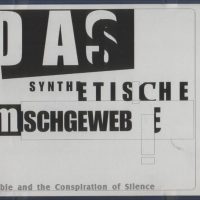
As a counterpoint to discourses about sound in nature, french sound artist Thomas Tilly continues his research on the use of noise by non humans. Following the noise walls of Codex Amphibia, Birds measuring space focuses on the strange rituals operating by the mysterious Guacharos de Cuevas, and its interpretation by humans and technology.
–
«It is difficult to form an idea of the horrible noise occasioned by thousands of these birds in the dark part of the cavern, {…}. The shrill and piercing cries of the guacharoes strike upon the vaults of the rocks, and are repeated by the echo in the depth of the cavern».
— Alexander Von Humboldt (Von Humboldt’s diary)
BACKGROUND:
______________________________________________________________
During a 2016 trip to Colombia, I was very fortunate to be welcomed by the staff of the Rio Claro Natural Reserve, located in the central Cordillera. After several days of recording in the caves—the ones open to the public—inhabited by small colonies of cave-dwelling Guacharos (Steatornis caripensis), Juan Guillermo Garcés, director and founder of the Rio Claro sanctuary, allowed me to access a secret location outside of the reserve, home to what ornithologists reckon is one of the largest known colonies of these birds in Colombia.
The only species of its kind, the Cave Guacharos (also known as Oilbird), is a gregarious, cave-dwelling animal that has developed the rare echolocation abilities usually found in cetaceans, bats and, more rarely, mammals. While the vast majority of echolocation signals known to exist in the animal world operate in a spectrum that is inaudible to humans, the signals emitted by Guacharos occur in the medium/high range of our auditory spectrum.
Although Alexander Von Humboldt and Aimé Bonpland reported the existence of these animals to Europe in 1799, and Von Humboldt described them between 1814 and 1817, their nesting sites were already well known to indigenous populations, who saw them as the seat of evil spirits.
Traditionally used by these peoples for their meat and cooking oil, the Guacharos were largely decimated by the colonial presence in the area, then hunted until the 1960s before being listed as a protected species in the 1970s.
ABOUT THESE PIECES:
______________________________________________________________
The imagery of the bird as a symbol of an idealised nature, and its “music” as a representation of the beautiful and right sound, seem to me to be inconsistent with the “horrible noise made by the Guacharos”. To prioritise the class—in this case the aves, elevated to the status of an ecological totem—at the expense of the species, tends to perpetuate the major dualisms of modern Romanticism in the way of listening to environments. The Guacharos have developed their own mode of communication and navigation, in the same way as bats, by adapting to a unique context that has little to do with the historical constructs associated with tropical forests and the melodious songs that emanate from them.
The four recordings featured here follow the actual progression of listening to the phenomenon. They begin with the social calls in the caves and end with the gathering of several thousand birds in a strange whirling movement, from which only guiding signals emanate. These are presented without editing nor processing, simply for the forms and aesthetic qualities they generate—and perhaps one day they may become documentation.
Alongside these phonographies, a series of ‘analyses’ of the phonemes and echolocation signals is edited and mixed between the pieces.
These fragments are residues of the sound recordings; parts of the signal regarded by sound-cleaning software—a tool frequently used in music production—as unwanted frequencies and artefacts of digital audio coding (noise). Here, only this noise is kept, like a negative, and placed in relation to my field recordings.
Thomas Tilly | 2026